 Auto Alpha Advisory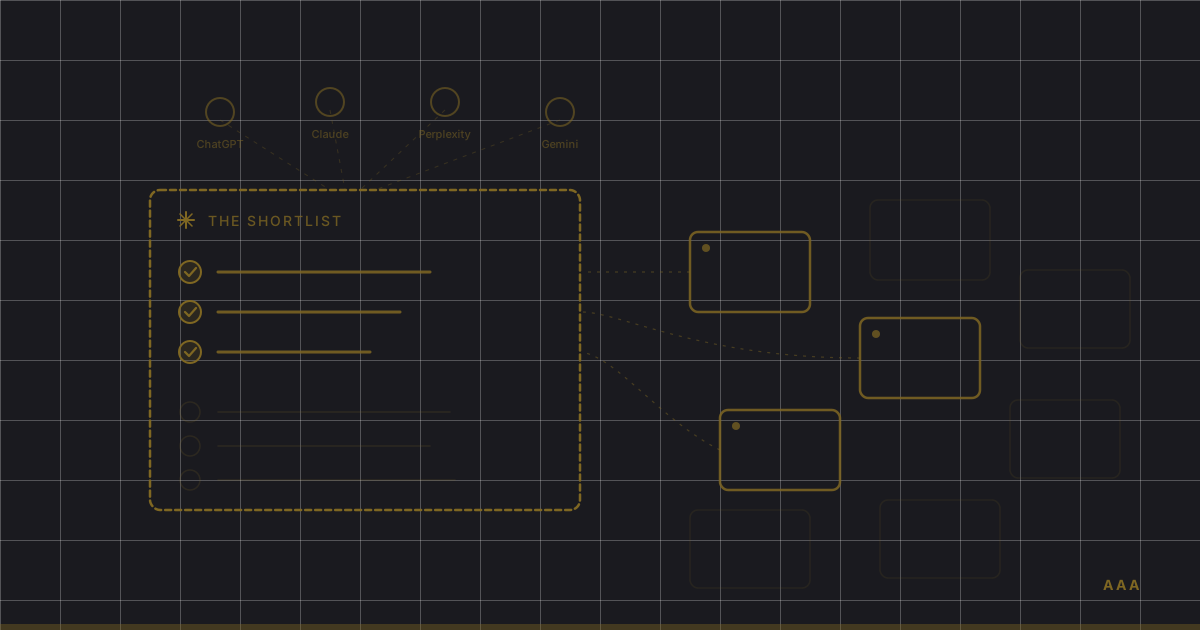
When someone asks ChatGPT "who should I list my house with in Cape Town?", or asks Perplexity "what's the best business bank for my startup?", they don't get a page of links to work through. They get a shortlist. Three or four names, written like fact. Your business is on it, or it isn't — and there's no page two, no sponsored slot, no SEO trick that puts you back in the running. What the assistant doesn't surface, the buyer never sees.
That shortlist is becoming the front door, and it runs on rules that have nothing to do with your Google ranking. The shift is already here: roughly a quarter of Google searches now return an AI Overview above the links (Conductor's analysis of 21.9 million queries, Conductor 2026 AEO/GEO Benchmarks), and organic click-through drops 61% on the searches where one appears (Seer Interactive, 25.1 million impressions). The answer is moving above the link list, and most South African business owners haven't looked at what it says about them.
What I actually measured
I'm a CA(SA) who now runs an AI-visibility agency — the evidence behind it tracks the same four engines this study does — so rather than theorise, I went and measured it. I took real buyer questions across three South African industries — residential property, business banking and crypto exchanges — and put them to the four assistants people actually use: ChatGPT, Claude, Perplexity and Gemini, for more than 600 grounded answers in all. Then I dissected every source each one cited to build its answer, and reverse-engineered why some brands get named and others, often bigger ones, get ignored.
Seven rules came back. They held across all three industries. Here they are, with what each one means for whether your business shows up.
That measurement now has a permanent home: the same panels, run the same way, are published as The SA AI Visibility Index — a recurring, date-stamped league table of who AI actually names in South Africa, with every prompt panel and the raw CSVs public. Edition 1 covers property and legal.
Rule 1 — It's not one race. It's four.
The most common mistake I see is a business checking "what does ChatGPT say about us" and assuming they've measured their AI visibility. You've measured a quarter of it, at most.
The four assistants behave like four different search engines. ChatGPT is the cautious one — it names the fewest brands, and roughly half the time it answers from memory without citing a single source. When it does point somewhere, it tends to point at the brand's own website. Claude and Gemini cast a wider net and lean on third-party sources: directories, comparison sites, guides. Perplexity is the social one — in property, nearly a fifth of what it cited was Facebook, YouTube, TikTok and Reddit, far more than any other engine.
Same question, four different answers, four different reasons. If your visibility plan isn't engine-by-engine, you're guessing.
Rule 2 — Crawlable beats clever: your robots.txt is lying to you
An assistant can only recommend a site its crawler is allowed to read. In the property study, two of the four biggest agencies in the country were blocking the AI crawlers at the server — and almost certainly didn't know it. One blocked every bot I tested; the other blocked ChatGPT's specifically. The tell was brutal: on the engine that was blocked, the brand's own site was cited zero times, while on the engines that weren't, it was cited dozens of times.
Here's the part that should worry any business that has already "checked": their robots.txt file said the AI bots were welcome. The block was happening one layer deeper, at the web server or firewall, invisible to the standard SEO check everyone runs. This matters because the crawlers behind ChatGPT, Claude and Perplexity don't render JavaScript and don't behave like Googlebot — a Vercel and MERJ study confirmed they fetch raw HTML and little else. The only way to catch a block is to fetch your own site as the AI crawler and see what comes back. Almost no one does. It's nearly always a stock security setting nobody chose, and it's a one-line fix — but only if you know to look.
Edition 1 of the Index found the starkest version of this yet: Bowmans — the law firm AI names more than any other in South Africa — serves 403s to GPTBot, ClaudeBot and PerplexityBot. It stays visible only because the legal directories speak for it. Four of the six most-visible SA law firms have sites the AI crawlers can't fully read.
Rule 3 — In a crowded market, get onto the sources AI already trusts
For "best X" questions in a well-covered industry, the assistant mostly isn't reading brand websites. It's reading the middlemen. In property, ten third-party sites — the big portals, a handful of review and comparison sites — carried nearly a third of every citation. In banking, the single most-cited source for "best business bank" wasn't a bank at all; it was a government-guide site and an overseas accounting blog. In crypto, it was tax calculators and comparison sites.
The pattern was iron: the two clearest losers in property had a presence on zero of those sites. Famous locally, invisible on the pages AI actually reads. This is the mechanism behind a finding from Airops — that brands are roughly 6.5× more likely to be cited through third-party sources than through their own domain. If you're in a crowded category, being on those middleman sources isn't a marketing nice-to-have. It's the floor you have to clear to be in the conversation at all.
Rule 4 — In a thin market, your own site is the source
The opposite is just as true, and it's where smaller brands win. In young or thin South African categories — solar, immigration services, online schooling — there are no trusted middlemen for the assistant to lean on. So it falls back on the best thing it can find: a well-built brand website. I watched a solar company's own site become the single most-cited source in its entire category, beating every directory and comparison site, because there weren't any worth citing.
The lesson is that the right move depends on how crowded your category is. Crowded, get onto the trusted third parties. Thin, become the definitive source yourself. Most GEO advice ignores this distinction entirely. Knowing which game you're in is half the work — and if you're newer than your competitors, this is quietly good news.
Rule 5 — Be the answer, not the address
When an assistant does cite a brand's own site, which page it picks tells you everything. The brands that win citations get cited for pages that answer the buyer's question: "what commission do agents charge", "how to choose an agent", "sole vs open mandate". The brands that lose get cited, if at all, for thin contact and office pages — an address, not an answer. One large agency's most substantial pages were 11,000-word directories of staff names. High word count, zero answer. The assistant walked past them.
This is exactly how the retrieval works. As Aleyda Solis, founder of Orainti, puts it:
"AI search engines don't index or retrieve whole pages; they break content into passages."
If your site doesn't contain passages that answer the questions buyers actually ask, you're handing those citations to whoever does.
Rule 6 — Schema and SEO aren't the secret
Here's the finding that breaks the GEO-consultant playbook. The single most-recommended estate agency in the country had zero structured data — no schema markup at all — on its homepage. The brand with the most schema ranked mid-table. Across the board, the fashionable technical checklist — schema, JSON-LD, the works — did not separate the winners from the losers.
What did? Three things, in order: corroboration (are you on the sources AI already trusts), authority (does your brand have a real organic search footprint — this correlated most strongly of any single number I measured), and category fit. That last one matters more than it sounds: one of South Africa's largest financial-services brands scored a flat zero for "best business bank", because it's an insurer, not a bank. All the authority in the world won't earn you a recommendation in a category you don't credibly belong to.
None of this means schema is worthless — it means it isn't the lever the market is selling it as. Lily Ray, VP of SEO and AI Search at Amsive, put the relationship between the old discipline and the new one bluntly:
"GEO gets the credit. SEO did the work."
The brands getting recommended built genuine authority the slow way. The markup is the easy part, and it's not what's deciding the shortlist.
Rule 7 — Famous offline doesn't mean visible to AI
This is the hardest truth for established brands. A celebrated luxury agency that built its name on one prestige market barely registered when I asked the assistants about that exact market — they named its competitors instead. A crypto exchange whose own website the assistants could barely read still got recommended second in the country, because the rest of the internet vouched for it.
Your reputation in the room counts for nothing if it hasn't been written down on the pages machines read. AI doesn't know who's respected. It knows who's corroborated.
What this means for your business
Strip it back and the playbook is short, and honest:
- Check all four engines, not one. Your ChatGPT result is not your visibility.
- Fetch your own site as an AI crawler. Not your
robots.txt— the actual server response, per bot. This is the cheapest, highest-impact thing on this list, and the one almost no one does. - Work out which game you're in. Crowded category, get onto the third-party sources AI cites. Thin category, make your own site the definitive answer.
- Build pages that answer questions, not pages that list your offices.
- Stop over-investing in schema and start investing in corroboration and genuine category authority.
None of this shows up in your Google rankings. It's a separate race, it's already running, and most South African brands haven't noticed it started. The businesses that start now will own their category's answer before competitors notice the question changed.
An honest caveat, because I'd rather be trusted than impressive: AI answers shift week to week, this is a point-in-time read, and these are patterns I measured, not laws of physics. If you want to know how your own brand is doing right now rather than wait for the next study, AIV runs this same measurement — ChatGPT, Claude, Perplexity, Gemini — against your brand every month. Ticking these boxes doesn't guarantee a recommendation. What the data shows is what the brands that do get recommended have in common. The only real proof is moving a brand from invisible to cited and watching it happen.
Frequently Asked Questions
How do I check if AI recommends my business?
Open ChatGPT, Claude, Perplexity and Gemini and ask each one for the best provider in your category in your city. Note whether you're named, who's named instead, and whether the assistant cites a source. Do it on all four — they disagree more than you'd expect, so one engine tells you almost nothing.
Is my website blocking AI crawlers without me knowing?
Possibly. Your robots.txt can say AI bots are welcome while your web server or firewall quietly turns them away — a stock security setting nobody chose. The only way to know is to fetch your site as each AI crawler and check the response. In one study, two of the four biggest property agencies in the country were blocked this way and had no idea.
Does schema markup help with AI search?
Less than you've been told. In my study the most-recommended brand had no schema at all, and the brand with the most schema ranked mid-table. Schema is worth doing correctly, but corroboration from sources AI trusts and genuine category authority matter far more. Treat schema as hygiene, not strategy.
How much does an AI visibility audit cost in South Africa?
A proper audit checks all four engines, the per-bot crawler response, the third-party sources in your category, and which of your pages get cited. You can start with a free automated check, and a full website audit and rebuild with AI-search readiness built in runs from R15,000 to R50,000 depending on scope. See our services for what's included.
Can a small business outrank a big brand in AI answers?
Yes — more easily than in traditional search. AI assistants reward corroboration and clear, answer-shaped pages over size and ad budget. In thin categories, a well-built small-brand site routinely beats bigger competitors because there are no trusted middlemen for the assistant to fall back on.
So where do you stand? You can't tell from a framework — the answer is specific to your brand, your category and your city. Start with a free audit to see whether AI is even allowed to read your site, then read why your website might be invisible to AI search and the technical breakdown of GEO for the fixes. Or book a discovery call — 30 minutes, no pitch, just an honest read on where you land.
Sources · 6
- Conductor — 2026 AEO/GEO Benchmarks Report (25.11% of Google searches trigger AI Overviews; 21.9M queries)
- Seer Interactive — AI Overview impact on organic CTR (61% CTR drop on AI Overview queries; 35% higher CTR for cited brands)
- Vercel / MERJ — How AI crawlers interact with the web (GPTBot, ClaudeBot and PerplexityBot do not render JavaScript)
- Airops — third-party citation research (brands ~6.5× more likely to be cited via third-party sources than their own domain)
- Princeton GEO paper, KDD 2024 (citing sources gives rank-5 pages a +115% visibility lift)
- Aleyda Solis — AI Search Optimization Roadmap (passage-level retrieval)