 Auto Alpha Advisory
Every morning I used to spend 1–2 hours doing the same thing: scanning X, checking CoinDesk, scrolling through Telegram groups, and trying to figure out which of my 80+ crypto holdings had news that actually mattered. Most days, 95% of what I read was noise. But I couldn't skip it — because the one day I didn't check was always the day something moved.
So I built a bot to do it for me. It runs at 5 AM from a server in Cape Town, costs about $12 a month (roughly R220 at current rates), and delivers a cleaner briefing than I ever produced manually.
The problem with manual monitoring
The issue isn't finding information. It's filtering it. There are hundreds of crypto news sources, thousands of tweets, and dozens of Telegram channels. The signal-to-noise ratio is terrible. I'm not alone in this: 62% of workers in Microsoft's Work Trend Index say they struggle with too much time spent searching for information in their workday.
What I actually needed each morning was simple: the 3–5 things that matter across my portfolio, with enough context to decide whether to act. Not a firehose of everything published in the last 24 hours.
No existing tool did this well. Crypto news aggregators give you everything. Portfolio trackers give you prices but no context. Twitter lists give you opinions but no filtering. I wanted intelligence, not information.
The stack
- Python — 1,173 lines total. That's it.
- Claude API — for relevance scoring and digest synthesis
- Tavily — web and news search per asset
- FireCrawl — X/Twitter scraping for social signals
- CoinGecko API — price data (24h change, volume)
- AgentMail — HTML email delivery
- DigitalOcean — one $6/month droplet running a cron job
How the pipeline works
The bot runs a 6-stage pipeline every morning:
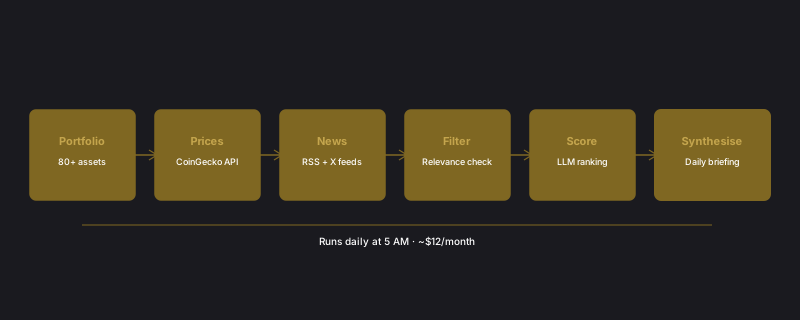
Stage 1: Load portfolio. Read a JSON config file with all 80+ assets, tiered by portfolio value. The top 20 get daily coverage. The remaining 60 get Monday/Friday coverage. This keeps API costs within free tier limits.
Stage 2: Fetch prices. Hit CoinGecko for current prices, 24h changes, and volume. This is the baseline — the bot needs to know what moved before searching for why.
Stage 3: Search for news. Tavily searches for web and news mentions of each asset from the last 24 hours. FireCrawl scrapes X/Twitter for the top-20 assets, filtered by engagement.
Stage 4: Keyword pre-filter. A fast, cheap filter that discards results that don't match asset-specific keywords. This cuts 60–70% of results before they touch the LLM — which is the most expensive step.
Stage 5: LLM relevance scoring. Claude scores each remaining item 1–10. Anything below 7 gets dropped. Same-story items are grouped, keeping the best source. This is where the magic happens — an LLM can judge relevance in a way that keyword filters can't.
Stage 6: Synthesis and delivery. Claude writes the final digest in a Bloomberg-style format. Per-asset sections with "What happened" and "Why it matters." If nothing material happened for an asset, it gets a one-line "No material updates" — no manufactured content.
The result lands in my inbox as a clean HTML email before I wake up.
The economics of hybrid filtering
The most interesting design decision was the hybrid filtering approach. LLM API calls are the most expensive part of any AI pipeline. They're also getting cheaper fast — Sam Altman's rule of thumb is that "the cost to use a given level of AI falls about 10x every 12 months, and lower prices lead to much more use" — but the design principle stands regardless: don't pay an LLM to read what a keyword filter can discard for free. If I sent every search result to Claude for scoring, the daily cost would be $3–5. That's $90–150/month for a morning newsletter — and the per-token rates are public, so you can do this arithmetic before you build (Anthropic pricing).
Instead, the keyword pre-filter eliminates obvious noise before the LLM ever sees it. A tweet about "SOL" that doesn't mention Solana, blockchain, validator, or any related terms? Discarded. A news article about a company called "Chainlink" that's actually about supply chain logistics? Gone.
This drops the volume by 60–70%, which means Claude only scores the stuff that has a reasonable chance of being relevant. Total LLM cost: about $4–8/month. Add $2 for Tavily and CoinGecko, $6 for the server, and you're at $12–16/month total.
That's the economics of practical AI: the cheapest solution that's good enough will beat the expensive one every time. The same logic drives the five automations I recommend to almost every business — small, cheap, and provable before you scale them. And the maths only improves: Stanford's 2025 AI Index found the cost of querying a model performing at GPT-3.5 level fell from $20 to $0.07 per million tokens between November 2022 and October 2024 — a more than 280-fold drop in under two years.
What the output looks like
Here's a representative digest:
Portfolio Briefing — 6 March 2026
Top Stories
- Solana Firedancer upgrade goes live on mainnet
- SEC delays spot ETH ETF decision to Q3
Solana (SOL) — $142.50 (+8.2%) What happened: Firedancer validator client launched on mainnet, processing 10x more transactions per second. Why it matters: Major technical milestone that could attract institutional validators and increase throughput. Sources: The Block, CoinDesk
On quiet days — and most days are quiet for most assets — the digest is short. That's the point. I don't want content for content's sake. I want signal.
Build timeline
This project took half a day from idea to production. That's not a typo.
The architecture is simple — a linear pipeline with no complex state management, no frontend, no database. Each stage feeds into the next. Claude wrote most of the API integration code and the HTML email template. I spent my time on the filtering logic and prompt engineering — the parts that determine whether the output is useful or not.
By the end of the afternoon it was deployed on DigitalOcean, cron job set, and the first real briefing landed in my inbox the next morning. A few days of threshold tuning after that — adjusting which relevance scores to keep, tweaking keyword lists — and it's been running reliably since.
What I'd do differently
Better deduplication earlier. The same story often appears on five different sites with slightly different headlines. My deduplication catches most of it, but not all. A fuzzy title matching step before LLM scoring would save more API calls.
Configurable output depth. Some mornings I want the full briefing. Some mornings I just want the top 3. A "headline only" mode would be useful for quick scanning.
Smarter tiering. The current top-20/rest split is based on portfolio value, but some smaller holdings are more volatile and news-sensitive. Tiering by volatility or recent activity would be smarter.
The business lesson
This project is the clearest example of what AI automation actually looks like for most businesses.
It's not a chatbot. It's not an agent. It's a pipeline that takes a manual, repetitive, cognitive task — scanning dozens of sources, filtering for relevance, synthesising a summary — and does it automatically, consistently, and cheaply.
Every business has a version of this. Anthropic's Economic Index — built from millions of real Claude conversations — found AI already being used in at least a quarter of the tasks in 36% of occupations, and 57% of that usage is augmentation (AI helping a person do the work) rather than outright automation. A finance team that manually compiles weekly reports from multiple data sources. A sales team that scans competitor websites for pricing changes. A compliance team that monitors regulatory updates across jurisdictions. An operations manager who checks five dashboards every morning to see if anything needs attention.
The pattern is always the same: gather data from multiple sources, filter for what matters, summarise for a human to act on. The tools to build it are the same ones I used — Python, an LLM API, and a few data connectors. The infrastructure is a cron job on a $6 server. (That's DigitalOcean's smallest Basic Droplet — 1 vCPU and 1 GiB of RAM at $6.00/month — and it's more than enough for a linear pipeline.)
Not every AI solution needs to be complex. Sometimes the right answer is a well-designed script that runs at 5 AM and saves you 1–2 hours before breakfast.
Frequently Asked Questions
How do you automate daily reporting with AI?
Build a pipeline that runs on a schedule (a cron job on a cheap server). It gathers data from your sources via APIs, filters for relevance using keyword matching and LLM scoring, synthesises the results into a formatted report, and delivers it by email or Slack. The architecture is simple — a linear script with no frontend or database required.
How much does an AI automation pipeline cost?
A basic pipeline runs on a R100/month server with R50–150/month in API costs depending on volume. Total: R200–400/month. Compare that to the salary cost of 1–2 hours of daily manual work. The build itself takes a day or two for a technical consultant.
Can AI replace manual data gathering?
For structured, repeatable data gathering — absolutely. If you're scanning the same sources daily, filtering for relevance, and summarising for a team — that's exactly what AI pipelines do well. The key is the hybrid filtering approach: cheap keyword filters first to cut volume, then LLM scoring for the nuanced relevance judgements.
What tools do you need to build an AI pipeline?
Python (the language), an LLM API (Claude or GPT for scoring and synthesis), data source APIs (whatever you're monitoring — news, prices, competitor sites), and a server to run it on. The entire stack can be under 1,200 lines of code. No frameworks, no databases, no frontend.
If your business has a process that looks like this — manual information gathering followed by filtering and summarising — let's talk about what automating it would look like.