 Auto Alpha Advisory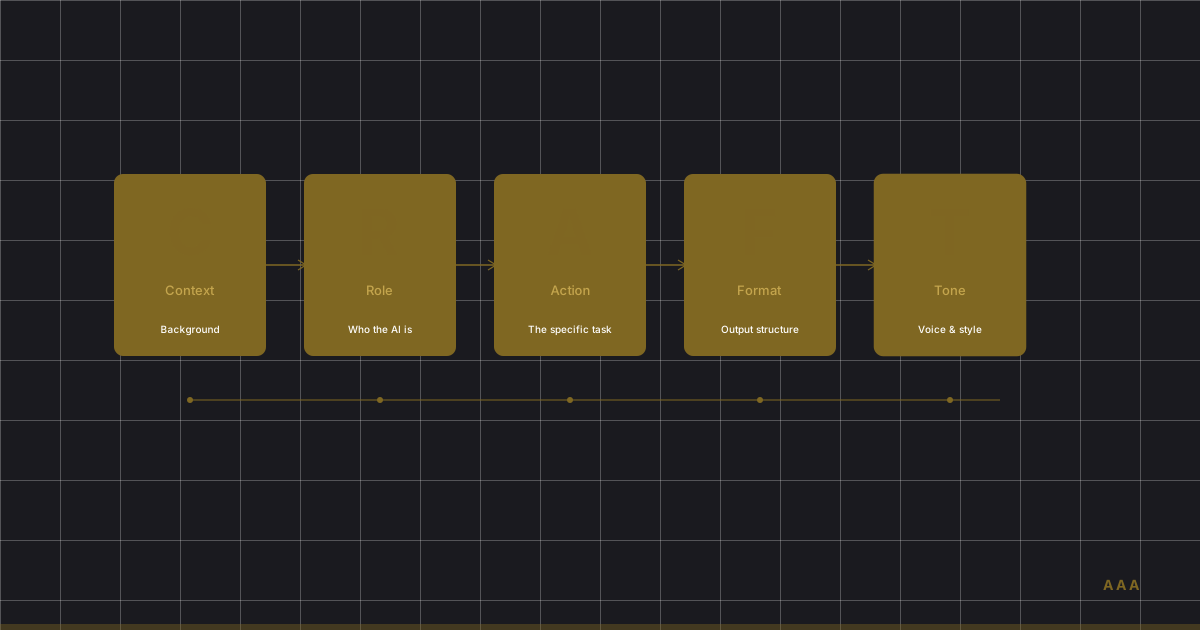
Open ChatGPT. Type "write me a business plan." Hit enter. Read four pages of generic, Wikipedia-level output that applies to no business in particular. Close the tab. Conclude that AI is overhyped.
I've watched this cycle dozens of times. Business owners, managers, skilled professionals — smart people who tried AI once, got nothing useful back, and walked away thinking the tool was the problem. They're not a fringe group either. Stanford's 2025 AI Index found that 78% of organisations reported using AI in 2024, up from 55% the year before — which means most businesses are already asking these tools questions, and most are asking them badly.
It wasn't. The prompt was.
The difference between someone who gets mediocre results from AI and someone who gets genuinely useful output is almost never about which tool they use. It's about how they ask. And the gap between a lazy prompt and a well-structured one is enormous — we're talking the difference between a Wikipedia summary and a document you'd actually use in your business. The upside is real and measured: when MIT researchers gave professionals ChatGPT for business writing tasks, completion time dropped by 40% and output quality rose by 18% in a study published in Science. How you prompt decides whether you actually collect that gain.
I use a framework called CRAFT for every meaningful prompt I write. It takes about 60 seconds longer than typing a vague question, and the output quality isn't incrementally better — it's categorically different. Prompting has become a genuine field of study — a 2024 systematic survey, The Prompt Report, catalogues 58 distinct text-based prompting techniques. You don't need 58. You need five, applied every time.
What CRAFT stands for
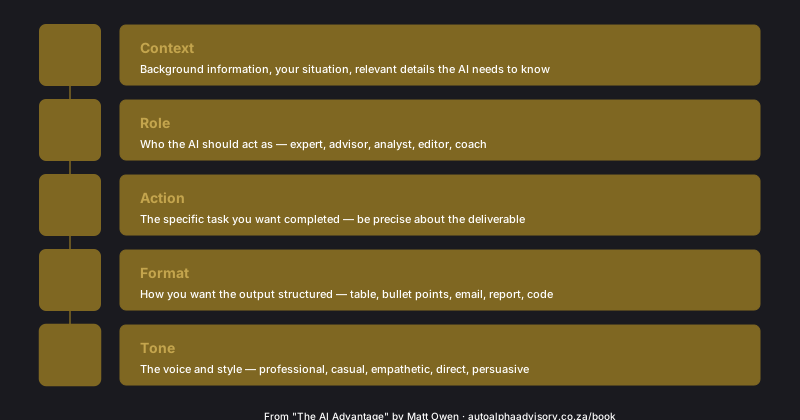
C — Context. The background information the AI needs. Your industry, your situation, your constraints, the specific problem you're solving. Without context, the AI has to guess — and it will guess generically.
R — Role. Who you want the AI to act as. An experienced property lawyer. A restaurant operations consultant. A financial analyst who specialises in SME lending. The role shapes the perspective, vocabulary, and depth of the response.
A — Action. The specific task you want completed. Not "help me with marketing" but "write three email sequences for re-engaging lapsed customers." The more precise the action, the more useful the output.
F — Format. How you want the output structured. A table, a numbered list, a formal report, an email draft, a week-by-week timeline. If you don't specify format, the AI defaults to generic paragraphs — which is rarely what you actually need.
T — Tone. The voice and style of the response. Professional and formal for a board memo. Conversational and warm for a customer email. Direct and no-nonsense for an internal operations plan. Tone controls whether the output sounds like it came from your business or from a textbook.
The before and after
Let me show you the difference with a real scenario. Say you're a property manager with 12 residential units and you're dealing with a spike in tenant complaints.
The vague prompt:
"How do I handle tenant complaints?"
You'll get a generic article about complaint management. Active listening. Documenting issues. Being responsive. All correct, all useless. It reads like a first-year property management textbook because the AI had nothing specific to work with.
The same request using CRAFT:
Context: I manage 12 residential rental units across two apartment blocks in Cape Town. Over the past month, I've received 8 complaints — mostly about water pressure issues in Block B and noise from a specific unit in Block A. I've fixed the water pressure (plumber confirmed), but the noise complaints keep coming and the tenant causing the issue is on a 12-month lease with 7 months remaining.
Role: You are an experienced residential property manager in South Africa who understands the Rental Housing Act and has dealt with tenant disputes for 15+ years.
Action: Give me a step-by-step plan for resolving the ongoing noise complaint, including what I can legally do, how to document the issue properly, and at what point I can escalate to the Rental Housing Tribunal.
Format: Numbered steps in chronological order, with a separate section on legal considerations under South African rental law.
Tone: Direct and practical. Written for someone who manages properties hands-on, not a corporate REIT.
The output from this prompt is immediately actionable. It references the right legislation. It gives you specific steps — written notice templates, documentation requirements, tribunal referral thresholds. It's written for your situation, not for a textbook.
Same AI. Same subscription. Completely different result.
CRAFT in action: three business scenarios
To show how versatile this is, here's CRAFT applied to three different business situations.
Scenario 1: Restaurant owner analysing food costs
- C: "I own a 60-seat casual dining restaurant. Food cost has crept from 28% to 34% over the past quarter. My top-selling dishes are still the same. I suspect portion drift and supplier pricing, but I haven't done a formal analysis."
- R: "You are a restaurant operations consultant who has worked with independent restaurants doing R80K–R200K monthly revenue."
- A: "Identify the five most likely causes of food cost increase for a restaurant in my situation, and give me a checklist for investigating each one this week."
- F: "A table with columns: Likely Cause, How to Check, What Good Looks Like, Red Flag."
- T: "Straightforward and practical. No theory — just what to do."
Scenario 2: Financial services firm drafting a compliance update
- C: "We're a licensed FSP in South Africa. The FSCA recently published updated FAIS fit-and-proper requirements that take effect in June 2026. We have 14 representatives who need to be assessed against the new criteria."
- R: "You are a compliance officer with deep knowledge of the FAIS Act, FAIS General Code of Conduct, and FSCA Board Notices."
- A: "Draft an internal memo to our representatives explaining what's changing, what they need to do, and by when. Include a summary table of the key requirement changes."
- F: "Professional internal memo format with a summary table at the top, followed by a detailed explanation of each change."
- T: "Authoritative but accessible. These are qualified professionals, not compliance experts — explain the requirements clearly without dumbing them down."
Scenario 3: Small business owner writing a job advert
- C: "I run a 10-person digital agency in Johannesburg. I need to hire a mid-level project manager who can handle 3–4 client accounts simultaneously. We use Monday.com for project management and Slack for communication. The role is hybrid — 3 days in office."
- R: "You are a hiring manager at a small agency who has written job adverts that attract strong candidates without corporate jargon."
- A: "Write a job advert for this role that I can post on LinkedIn and Careers24."
- F: "Standard job advert format: intro paragraph, responsibilities (bullet points), requirements (bullet points), what we offer, how to apply."
- T: "Confident and human. Show personality. We're a small team that works hard and doesn't take itself too seriously."
In each case, the CRAFT structure takes a vague idea — "help me with food costs," "draft a compliance thing," "write a job ad" — and turns it into a prompt that produces output you can actually use. No editing marathon required.
Why each element matters
You might be tempted to skip one or two elements. Don't.
Without Context, the AI writes for everyone and therefore for no one. It can't tailor advice to your industry, your size, your constraints, or your jurisdiction. Anthropic's own prompting documentation puts it plainly: "Think of Claude as a brilliant but new employee who lacks context on your norms and workflows. The more precisely you explain what you want, the better the result." That's the vendor telling you Context is not optional.
Context isn't a dump, though — it's a selection. Anthropic's guidance on context engineering frames it as a budgeting problem: "Context is a critical but finite resource." Give the model the three facts that change its answer, not the twenty that don't.
Without Role, you get a generalist response. A compliance memo written by a "helpful AI assistant" reads very differently from one written by "a South African compliance officer with 15 years of FAIS experience."
Without Action, the output wanders. It gives you background information when you wanted a decision framework. It explains a concept when you wanted a template.
Without Format, you get a wall of text. Specifying "table," "numbered steps," or "email format" is the difference between output you read once and output you paste directly into a document. The model vendors say the same thing — Google’s prompting guide for Gemini tells you outright: "You can give instructions that specify the format of the response. For example, you can ask for the response to be formatted as a table, bulleted list, elevator pitch, keywords, sentence, or paragraph."
Without Tone, the AI defaults to a neutral, slightly formal register that sounds like no human you've ever met. Specifying tone makes the output sound like something that could have come from your business.
None of this is vendor-specific, which is the useful part. Anthropic, Google and OpenAI all publish prompt-engineering guidance, and all three land on the same fundamentals: be explicit about context, state the task precisely, and specify the shape of the output. CRAFT is just a way to remember all five in the order you'd naturally think of them.
Try this now
Pick one task you've been meaning to ask AI about. This is also the framework behind every prompt in the four AI agents I run on my own business data — at that scale, sloppy prompts compound. Before you type the prompt, write down five things:
- What's the context? (Your business, your situation, the specific problem)
- What role should the AI play? (What kind of expert would you hire for this?)
- What's the specific action? (Not "help me with X" — what do you want delivered?)
- What format do you need? (Table, email, checklist, plan, memo)
- What tone fits? (Formal, direct, friendly, persuasive, technical)
Then write the prompt using all five. Compare the result to what you would have got from a one-line question.
The difference will be obvious. And once you've seen it, you won't go back to vague prompting.
Frequently Asked Questions
What is the CRAFT prompting framework?
CRAFT stands for Context, Role, Action, Format, and Tone — five elements that turn a vague AI prompt into a structured request that produces expert-level output. It works with any AI tool (ChatGPT, Claude, Gemini) and takes about 60 seconds longer than a one-line question.
How do I write better AI prompts?
Give the AI your specific context (industry, situation, constraints), assign it a role (the expert you'd hire), define the exact action you want, specify the output format (table, checklist, email), and set the tone (formal, direct, conversational). The more specific you are on all five elements, the more useful the output.
What makes a good ChatGPT prompt for business?
A good business prompt includes enough context for the AI to tailor its response to your industry, size, and jurisdiction. Generic prompts produce generic answers. A prompt that mentions your business type, location, team size, and the specific problem you're solving produces output you can actually use without heavy editing.
Does prompt structure really affect AI output quality?
Dramatically. The same AI model, given a one-line question versus a structured CRAFT prompt, will produce categorically different results. The structured version references relevant legislation, gives specific steps, and writes for your situation. The vague version reads like a Wikipedia article. Same tool, same subscription — completely different value.
CRAFT is one of the frameworks I cover in Chapter 4 of The AI Advantage — a free book I wrote for business owners who want to get practical value from AI without the hype. It includes a CRAFT one-pager you can print and keep next to your desk, plus a prompt library with ready-to-use templates for common business tasks. Download it free here.