 Auto Alpha Advisory
Most businesses approach AI backwards. They start with the technology — "we should use ChatGPT" or "let's build a chatbot" — and then look for problems to solve with it. That's like buying a forklift and then looking for heavy things to move. As a CA(SA) who's also built six production AI products, I've seen both the financial and technical sides of AI failure — and it almost always starts with skipping the discovery phase.
An AI Readiness Audit flips this. You start with your business processes, data, and pain points. Then you figure out which ones AI can actually improve — and which ones it can't.
What a readiness audit actually involves
It's not a questionnaire you fill out online. It's a structured assessment that typically takes two to three days and involves sitting down with your team to understand how your business actually runs.
Here's what I look at:
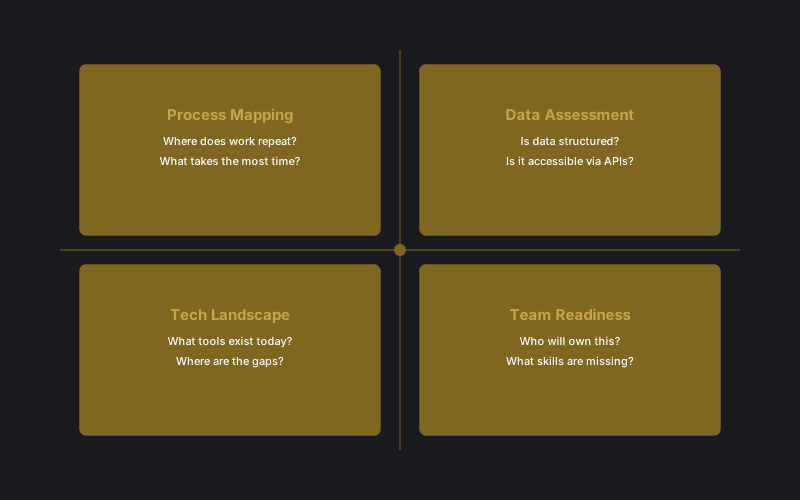
Process mapping. Every business has core workflows — how leads come in, how orders get processed, how reports get generated, how customers get supported. I map these out, looking for steps that are repetitive, rules-based, and time-consuming. These are your automation candidates.
Data assessment. AI needs data to be useful. Not perfect data — just data that exists and is accessible. I audit what you're collecting, where it lives, how structured it is, and what gaps would need filling. A CRM with three years of customer interactions is gold. A filing cabinet full of paper invoices needs a digitisation step first.
Technology landscape. What systems are you running? What APIs do they expose? Can they integrate with external tools? This determines what's technically feasible and what would require workarounds or replacements.
Team readiness. The best AI solution in the world fails if people won't use it. I assess your team's current comfort with technology, their appetite for change, and where training would be needed. This is where most projects actually die — BCG found around 70% of the challenges companies hit on AI initiatives stem from people and process issues, 20% from technology, and only 10% from the AI algorithms themselves.
Opportunity scoring. Each potential AI application gets rated on three axes: business impact (how much value it would create), technical feasibility (how hard it is to build), and adoption risk (how likely people are to actually use it). This gives you a prioritised list, not a vague "do AI" recommendation. Narrowing the list is the point: BCG's survey of 1,000 executives across 59 countries, Where's the Value in AI?, found that the companies actually getting value "pursue, on average, only about half as many opportunities as their less advanced peers" — and scale more than twice as many of them.
What you get at the end
A written report — typically 15 to 20 pages — that covers:
- A clear map of your current processes and where AI fits
- Specific recommendations ranked by ROI potential
- Realistic cost and timeline estimates for each opportunity
- A phased implementation roadmap — what to do first, second, third
- Tool and platform recommendations specific to your stack
- Data preparation steps if needed
No jargon. No theoretical frameworks. Just a practical document that tells you what to do and in what order.
Why most businesses need this before doing anything else
I've seen companies spend six figures on AI initiatives that didn't deliver. Not because AI doesn't work, but because they automated the wrong things, underestimated data requirements, or built solutions nobody used. The numbers bear this out: by some estimates more than 80% of AI projects fail — twice the rate of non-AI IT projects (RAND Corporation). The pattern is clear — businesses that skip discovery pay for it later. That RAND finding isn't opinion polling, either — the researchers interviewed 65 experienced data scientists and engineers and found the most common root cause of failure was business leadership misunderstanding what problem the AI needed to solve. Not the technology. The problem definition.
A readiness audit costs a fraction of a failed implementation and prevents the most common failure modes:
Automating the wrong process. Not every inefficiency is worth automating. Some processes are annoying but only take an hour a month. Others seem simple but have too many edge cases for current AI to handle reliably. As James Ryseff and his RAND co-authors put it in their study of AI project failure, "AI is not a magic wand that can make any challenging problem disappear" — and it's a lot cheaper to learn that in an audit than in production. An audit separates the high-value, feasible opportunities from the distractions.
Ignoring data reality. "We'll use AI to predict customer churn" sounds great until you realise your customer data is split across three systems with no common identifier. An audit surfaces these issues upfront, before you've committed budget.
Building without buy-in. If the people who'll use the AI solution weren't involved in choosing it, adoption will be low. The audit process involves your team from day one — they help identify the pain points, which means they're invested in the solution.
Overcommitting too early. A full AI transformation takes years. An audit gives you a clear first step — usually a single, focused implementation that delivers results in weeks, not months. Andrew Ng makes the same argument in How to Choose Your First AI Project: "The purpose of your first 1-2 pilot projects is only partly to create value; more importantly, the success of these projects will help convince stakeholders to invest in building up your company's AI capabilities." You prove value before scaling. The scrap-heap is bigger than most people think: S&P Global Market Intelligence found the share of companies abandoning most of their AI initiatives before production jumped from 17% to 42% in a single year — and the average organisation scrapped 46% of its proof-of-concepts.
Who needs one
Honestly? Any business with more than 10 employees and digital operations. If you want to sanity-check that before booking anything, I've written up the five signs a business is actually ready for AI — it's the same diagnostic, minus the invoice. If you have processes that involve data, communication, or decision-making (so, all of them), there are AI opportunities you're missing. And your competitors are already moving: Stanford's 2025 AI Index found that 78% of organisations reported using AI in 2024, up from 55% the year before.
The businesses I see get the most value are mid-market South African companies — 20 to 500 employees — that are big enough to have repetitive operational processes but not big enough to have an in-house AI team. They're in the sweet spot where AI can make a meaningful difference without requiring a massive investment.
Who doesn't need one
If you're a solo operator with simple processes, you probably don't need a formal audit. You can probably identify your own automation opportunities. Start with ChatGPT for your daily tasks and see where it saves time.
If you're an enterprise with an existing data science team, you need something more specialised — not a broad readiness assessment, but deep technical architecture work.
The audit is designed for the middle — businesses that know AI matters but don't have the internal expertise to know where to start.
The cost of not doing one
The real risk isn't spending money on an audit you didn't need. It's spending ten times that on an AI project that doesn't deliver because you skipped the discovery phase.
I've consulted on projects where the technology worked perfectly but the business case was wrong. The automation saved 30 minutes a week on a process nobody cared about. Meanwhile, the process next door — the one that was costing real money — went untouched because nobody mapped it out properly.
An audit is cheap insurance against expensive mistakes.
Next step
If you're wondering where AI fits in your business, that's exactly the question a readiness audit is designed to answer. Book my discovery call and we'll spend 30 minutes understanding your business before deciding if an audit makes sense. No commitment, no pitch — just a conversation.
Frequently Asked Questions
What is an AI readiness audit?
A structured assessment of your business processes, data, technology, and team to identify where AI can deliver real value — and where it can't. You get a prioritised roadmap with cost estimates and realistic timelines, not a generic "do AI" recommendation.
How long does an AI readiness audit take?
Typically two to three days of on-site or remote assessment, followed by a written report delivered within a week. The process involves mapping your workflows, auditing your data, and scoring opportunities by impact, feasibility, and adoption risk.
How much does an AI audit cost in South Africa?
What this costs with me, specifically: the mapping session that does the diagnostic work described above is free, and a first automation pilot starts from R30,000. If the question is narrower — whether your website is readable by the AI engines your buyers now ask — that's the nine-domain audit at R1,490, one-time. Either way it's a fraction of what a failed AI implementation costs, and it tells you exactly where to invest (and where not to).
Do I need technical knowledge for an AI audit?
No. The audit is designed for business leaders, not engineers. You bring knowledge of your operations, processes, and pain points. The auditor brings the technical evaluation and translates opportunities into business language.