 Auto Alpha Advisory
Every business I talk to — from professional services firms in Cape Town to logistics companies across South Africa — is somewhere on the AI spectrum. Some are using ChatGPT for ad hoc tasks. Some have heard about AI agents and want one. Most are somewhere in between, unsure of what they actually need. That's not a small crowd, either — Stanford's 2025 AI Index found that 78% of organisations used AI in 2024, up from 55% the year before. Adoption has outrun clarity.
The truth is, there's a clear hierarchy of AI implementation — and knowing where you sit on it saves you from building too much or too little. Here's how I think about it.
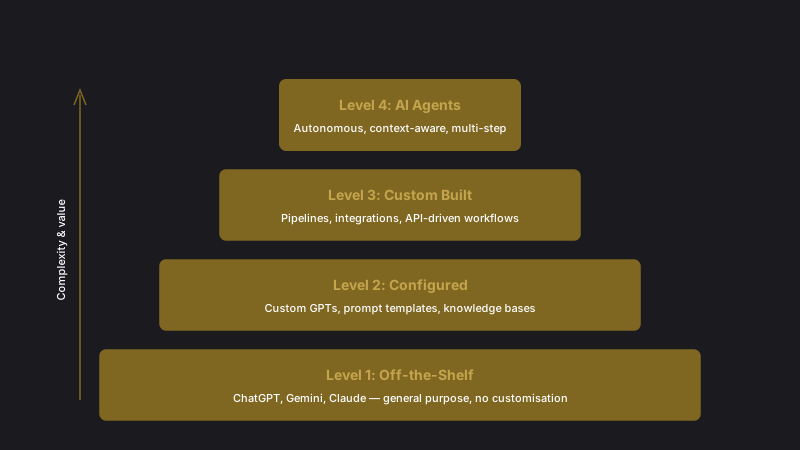
Level 1: Off-the-shelf AI tools
This is where most businesses should start, and where many should stay for a while.
ChatGPT, Claude, Gemini, Copilot — these tools are immediately useful for everyday tasks. Writing emails, summarising documents, drafting proposals, brainstorming ideas, analysing data in spreadsheets. No integration required. No development cost. Just a subscription and some time learning prompts.
When this is enough: Your team has ad hoc needs. Different people use AI for different things. The tasks are varied and don't follow a strict process. You're still figuring out where AI helps most.
When it's not: The same person does the same AI-assisted task dozens of times a day. You need consistent outputs that follow company-specific rules. You need AI to interact with your internal systems.
Most businesses underestimate how much value they can extract from this level. Before building anything custom, make sure your team is actually using the off-the-shelf tools well. You'd be surprised how many companies want to build a custom chatbot when they haven't even tried giving ChatGPT their product documentation.
Level 2: Configured AI workflows
This is the step most businesses skip — and it's often the sweet spot.
Tools like Make.com, Zapier, and n8n let you connect AI models to your existing systems without writing code. If you want concrete starting points, five automations most businesses can set up in a week covers the ones that pay back fastest. You can build workflows like:
- New email arrives → AI classifies it → Routes to the right person
- Customer fills out a form → AI generates a personalised response → Sends it
- Weekly data drops into a spreadsheet → AI summarises trends → Posts to Slack
These aren't "agents." They're automated workflows with AI in the middle. They're predictable, easy to monitor, and cheap to run. And they solve 80% of what businesses think they need a custom AI agent for.
When this is enough: Your process is linear — A triggers B triggers C. The AI step doesn't need to make complex decisions or access multiple data sources simultaneously. You want something running in days, not weeks.
When it's not: The process requires multi-step reasoning, dynamic decision-making, or real-time interaction with users. The AI needs to pull from multiple systems, weigh context, and take different actions depending on what it finds.
Level 3: Custom AI integrations
Now we're writing code. This is where you build AI directly into your existing software — your CRM, your internal dashboard, your customer portal.
Examples:
- An AI-powered search bar on your internal knowledge base that understands natural language queries
- Automated analysis of incoming documents (contracts, invoices, applications) that extracts key fields and flags anomalies
- A recommendation engine in your e-commerce platform that personalises product suggestions based on browsing history
These are custom builds, but they're bounded. They do one specific thing well. They're integrated into a system you already have. They're maintainable because the scope is clear.
When this is the right call: You have a specific, high-value process that off-the-shelf tools can't handle. The volume justifies the development cost. The process is stable enough that you're not rebuilding every month.
When to go further: The task requires autonomy — the AI needs to decide what to do next, not just process a fixed pipeline.
Level 4: Custom AI agents
This is the top of the stack, and it's where most of the hype lives. An AI agent is software that can reason about a task, decide on next steps, use tools, and operate with some degree of autonomy.
A customer service agent that can handle multi-turn conversations, look up order histories, process refunds, and escalate to a human when it's out of its depth. A research agent that monitors competitor pricing, analyses market trends, and generates weekly briefings without being asked. I've written up what it actually took to build agents that know a business well enough to be useful — the hard part isn't the model, it's the knowledge layer underneath it.
These are powerful. They're also complex to build, harder to test, and require ongoing monitoring. An agent that goes off-script can do real damage — sending wrong information to customers, making incorrect data changes, or getting stuck in loops. Don't take my word for it — Anthropic, the company building these models, says in its guide to building effective agents that "the most successful implementations weren't using complex frameworks or specialized libraries. Instead, they were building with simple, composable patterns." Their advice, verbatim: find the simplest solution possible, and only increase complexity when needed.
When this is worth building: The task is complex enough that a simple workflow can't handle it. The volume is high enough to justify the development and maintenance cost. You have someone (internally or externally) who can monitor and tune the agent over time. And — critically — you've already proven the business case with simpler automation at levels 1–3.
That last condition is the one most businesses skip, and the data suggests it's expensive. BCG surveyed 1,000 executives across 59 countries for Where's the Value in AI? and found 74% had yet to show tangible value — with the companies that did succeed pursuing "only about half as many opportunities as their less advanced peers." Level 4 is where the ambitious projects die, because it's the level people jump to first.
When it's not: You're jumping to agents because they sound impressive. You haven't validated the underlying business logic with simpler tools first. You don't have a plan for monitoring and maintenance. The industry data backs the caution: Gartner predicts over 40% of agentic AI projects will be cancelled by the end of 2027, citing escalating costs, unclear business value and inadequate risk controls. "Most agentic AI projects right now are early stage experiments or proof of concepts that are mostly driven by hype and are often misapplied," says Anushree Verma, senior director analyst at Gartner.
How to decide
Here's the framework I use with clients:
Start at Level 1. Get your team using off-the-shelf tools. Identify which tasks they use AI for most frequently.
Graduate to Level 2 when you spot a repeating pattern. If the same AI-assisted task happens daily and follows a consistent process, automate it with a workflow tool.
Move to Level 3 when workflow tools hit their limits. Usually this means the task requires deeper integration with your systems or more sophisticated processing than a no-code tool can handle.
Consider Level 4 only when you've exhausted the previous levels for a specific use case. Agents should be the answer to "we've automated everything we can with simpler tools, and there's still a gap." Not the starting point.
The expensive mistake
The most expensive AI project I've seen was a custom agent built for a process that could have been handled by a Zapier workflow with a GPT step. Six weeks of development, ongoing hosting costs, and a maintenance burden — for something that could have been built in an afternoon. It's no surprise that 95% of corporate AI projects fail to deliver ROI (MIT 2025) — most of them over-engineered the solution. That figure comes from MIT's NANDA initiative and its The GenAI Divide: State of AI in Business 2025 report — Fortune's coverage notes it was built on 150 leadership interviews, a survey of 350 employees and analysis of 300 public AI deployments.
That's not a technology failure. It's a scoping failure. They started with the solution they wanted (a cool AI agent) instead of the problem they needed to solve (routing and responding to customer inquiries).
Bottom line
More AI is not always better AI. The right level of AI implementation is the simplest one that solves your problem reliably. Start simple, prove value, and escalate complexity only when the business case demands it.
Frequently Asked Questions
What's the difference between ChatGPT and a custom AI agent?
ChatGPT is a general-purpose AI tool — you ask it questions and it responds. A custom AI agent is purpose-built software that connects to your business systems, follows your specific rules, and can take actions autonomously (like triaging emails, processing documents, or generating reports). ChatGPT is a conversation. An agent is a workflow.
When should a business build a custom AI agent?
Only after you've exhausted simpler options. Start with off-the-shelf tools (Level 1), then automated workflows using Make.com or Zapier (Level 2), then custom integrations (Level 3). Build a custom agent (Level 4) only when the task requires multi-step reasoning, dynamic decision-making, and integration with multiple systems — and you've already proven the business case with simpler automation.
How much does a custom AI agent cost?
A focused custom AI agent for a South African mid-market business typically costs R50,000–R150,000 for the initial build, plus R2,000–R10,000/month in running costs depending on usage volume. But most businesses don't need a custom agent — a configured workflow at Level 2 can solve 80% of use cases at a fraction of the cost.
Do I need a developer to use AI in my business?
Not at Levels 1 and 2. Off-the-shelf tools like ChatGPT and no-code workflow platforms like Make.com require no coding. You only need development capability at Levels 3 and 4 — custom integrations and custom agents. That's where a technical AI consultant adds the most value.
If you're not sure which level is right for your business, that's a conversation worth having. Book a discovery call and I'll give you an honest assessment — even if the answer is "just use ChatGPT better."