 Auto Alpha Advisory
I'm not here to scare you into buying something. But I am going to be honest: the cost of doing nothing with AI in 2026 is higher than most business owners realise. Not because AI is some existential threat — but because your competitors are already using it, and the gap is widening. Consider this: S&P Global Market Intelligence's 2025 survey of 1,006 organisations found the proportion of companies abandoning most of their AI initiatives before production has risen from 17% to 42% in a year, with the average organisation scrapping 46% of its proof-of-concepts. That isn't a reason to wait — it's a reason to start properly. BCG's survey of 1,000 executives, Where's the Value in AI?, found the 26% who do capture value pulled ahead hard: 1.5× higher revenue growth, 1.6× greater shareholder returns and 1.4× higher return on invested capital over three years. The gap isn't between companies that use AI and companies that don't. It's between those who picked the right few things and those who didn't. Starting badly is nearly as expensive as not starting.
Having audited complex financial structures at KPMG before moving into AI implementation, I've seen what happens when businesses underestimate compounding disadvantages. This isn't theoretical. I've seen it play out across industries in South Africa and internationally over the past two years. Here's what "ignoring AI" actually costs in practice.
Your competitors are moving faster than you think
The narrative around AI adoption used to be that only big tech companies were doing it. That was true in 2023. It's not true anymore. Stanford's 2025 AI Index puts numbers on it: 78% of organisations reported using AI in 2024, up from 55% the year before — and the share using generative AI in at least one business function more than doubled, from 33% to 71%.
Mid-market businesses — accounting firms, logistics companies, recruitment agencies, property groups — are quietly deploying AI tools that give them measurable advantages. Mid-market AI adoption in South Africa still sits at just 2–5% (Auto Alpha Advisory market research, 2026), which means most of your local competitors haven't started either. But the ones who have are pulling ahead fast. Faster response times. Lower operational costs. Better customer experiences. They're not announcing it on LinkedIn. They're just doing it.
The company that responds to a customer inquiry in 30 seconds with an AI-assisted reply wins the deal over the company that takes 24 hours. The recruitment firm that screens 500 CVs in minutes places candidates faster than the one that takes a week. These aren't hypothetical scenarios. They're happening now.
The compounding effect
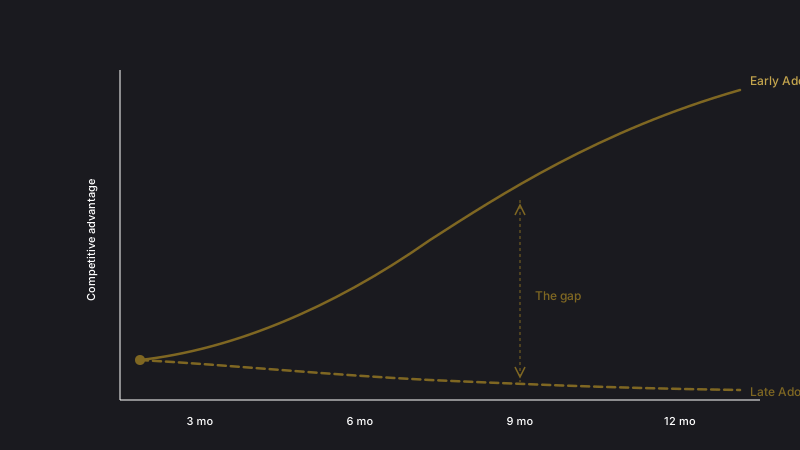
AI advantage compounds the same way interest does. A business that automated its customer triage six months ago has had six months of data to improve the system. Their AI is getting better while you're still doing it manually.
This is the part most people miss. It's not just about the immediate time saving. It's about the learning curve. Businesses that start now will be six months, twelve months, two years ahead of those that start later. And AI systems that learn from your data get better over time — meaning the early movers' advantage grows, not shrinks.
Waiting for the "right time" to adopt AI is like waiting for the right time to start investing. The best time was last year. The second best time is now.
What "doing nothing" actually costs
Let me make this concrete. Here are real costs I've calculated for businesses I've worked with:
Customer response delays. A professional services firm was losing an estimated 15–20% of inbound leads because their response time was over 24 hours. Prospects went to whoever replied first. An AI-assisted triage system brought response time under 2 minutes for standard inquiries. That's not an efficiency gain — it's revenue.
Manual report generation. A finance team spent three full days per month compiling management reports from multiple data sources. That's 36 person-days per year — roughly R250,000 in fully loaded salary cost — on copy-paste work that AI can do in minutes.
Inconsistent quality. A content-heavy business had three people writing customer communications. Quality varied wildly depending on who was working. An AI writing assistant with company-specific templates brought consistency up while cutting production time by 40%.
Missed patterns in data. A retail business was sitting on two years of transaction data but had never analysed it beyond basic revenue reporting. An AI-driven analysis identified three customer segments they weren't serving properly and a seasonal pattern they'd been misreading. That's not automation — it's insight that was invisible without the right tools.
The "we'll get to it next quarter" trap
Every business I work with says the same thing in their first meeting: "We know we need to do something with AI, we just haven't gotten around to it." Usually they've been saying that for 12 to 18 months.
The reason they haven't started isn't budget or technology. It's clarity. They don't know where to start, so they don't start at all. MIT's NANDA initiative found the same pattern at scale: 95% of generative AI pilots are failing to deliver measurable P&L impact — and the researchers found the root cause isn't the models, it's the "learning gap" in how organisations integrate the tools. Starting without a map is how you end up in the 95%. They're waiting for the obvious first step to present itself.
It won't. AI opportunities aren't obvious from the outside. They become obvious when someone maps your processes, looks at your data, and identifies where automation would have the highest impact. That's a structured exercise, not a lightning bolt of insight.
What AI doesn't cost
Let me balance this with what isn't expensive:
Starting small. A focused AI implementation — one process, one automation — typically costs less than a single new hire and delivers results in 4–8 weeks. You don't need a six-figure budget to begin.
Discovery. A readiness audit takes two to three days and gives you a clear picture of what's worth doing and what isn't. If the answer is "nothing right now," you've spent a fraction of what a premature implementation would have cost.
Experimentation. Many AI tools have free tiers or low-cost entry points. Your team can start using ChatGPT, Claude, or industry-specific tools tomorrow at minimal cost. The goal isn't to transform overnight — it's to build familiarity and identify where AI feels useful.
The uncomfortable truth
The businesses that thrive over the next five years won't be the ones with the biggest AI budgets. They'll be the ones that started earliest, learned fastest, and built AI into their operations incrementally.
Every month you wait, your competitors get a little further ahead. Not because they're smarter or better funded — because they started. Nvidia's Jensen Huang made the same point about individuals in an interview at Stanford: "It is unlikely most people will lose a job to AI. It is most likely that most people will lose their job to somebody who uses AI." The same logic applies to businesses.
What to do about it
You don't need to launch a massive AI initiative. You need to do three things:
- Get an honest assessment of where AI fits in your business. Not a vendor pitch — an independent evaluation of your processes, data, and opportunities. Before that, it's worth knowing what AI actually costs a South African business — real rand ranges, and the ROI formula I use before spending a cent.
- Pick one thing. The highest-impact, most feasible automation opportunity. Build it. Measure the results.
- Scale from there. Use the proof point to build internal confidence and expand to the next opportunity.
That's the playbook. It's not complicated. It's just disciplined.
Frequently Asked Questions
What happens if my business doesn't adopt AI?
You won't fail overnight. But you'll gradually lose ground to competitors who respond faster, operate cheaper, and spot patterns in their data that you're missing. The cost of inaction compounds — the longer you wait, the wider the gap.
How far behind is South Africa on AI adoption?
Mid-market AI adoption in South Africa is estimated at 2–5%, with enterprise at 10–20%. Compared to global averages, there's a significant lag — but that also means early movers in the SA market have a disproportionate advantage.
How much does it cost to start with AI?
A focused first implementation — one process, one automation — typically costs less than a single new hire and delivers results in 4–8 weeks. The mapping work that identifies the right starting point costs nothing, and a first pilot starts from R30,000. You don't need a transformation budget to begin.
What's the first step in AI adoption for a mid-market business?
Get an independent assessment of where AI fits in your specific operations. Not a vendor pitch — an honest evaluation of your processes, data, and opportunities. Pick the highest-impact, most feasible opportunity. Build it. Measure results. Scale from there.
If you want help with step one, that's what our AI Readiness Audit delivers. Or if you just want to talk through where you are, book a discovery call. It's free, it's fast, and I'll give you an honest answer about whether you should act now or wait.