 Auto Alpha Advisory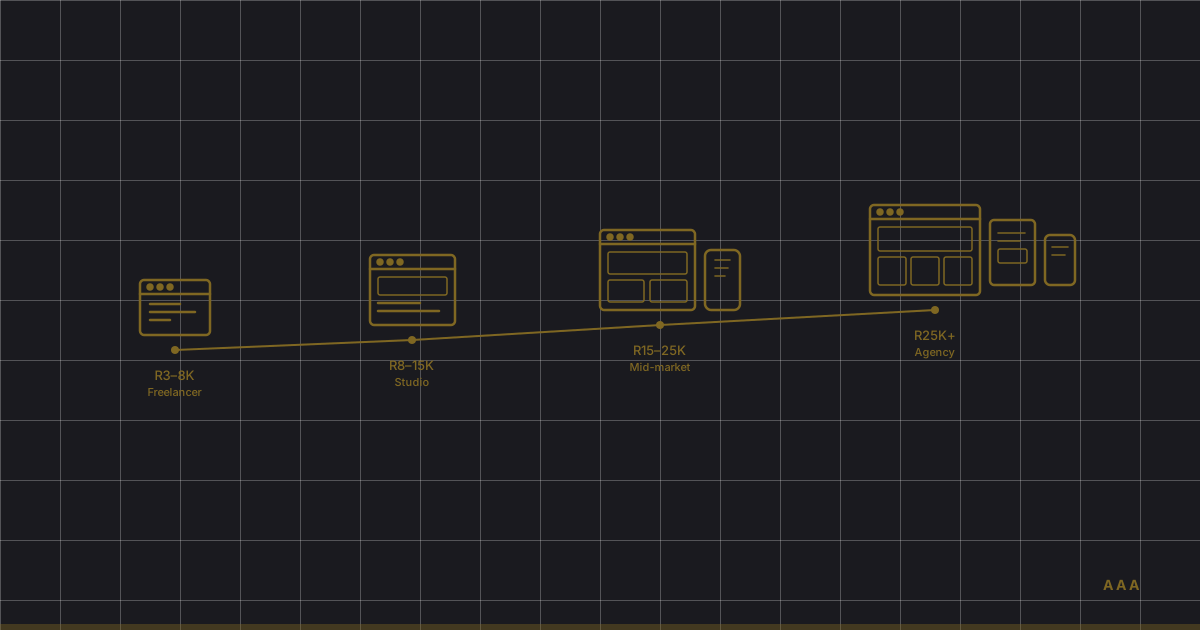
How much does a website cost in South Africa? For a small business in 2026, quotes typically run R7,500 to R20,000. A simple template site costs less, from about R3,800, and a custom build of more than 25 pages runs to R88,000. The Cape Town packages I found start at R1,500 to R4,590 for a basic site.
I'm a CA(SA) who builds websites for South African businesses, so I read a website quote the way I'd read any invoice: what's in it, what's been left out, and what it costs over three years rather than on the day you pay. The published numbers come first, then what I charge, including when you'd be better off paying someone cheaper.
How much does a website cost in South Africa in 2026?
A small business website costs R7,500 to R20,000 in South Africa and averages about R14,000, on the quotes ProCompare tracked when I read its website design price list on 18 October 2026.
ProCompare matches buyers with local professionals and publishes what they quote. In its words: "Thousands of people ask Procompare for help with their projects every year. We track the quotes they get from our local Pros and share those prices with you." Its ranges:
- A simple template site on WordPress or a similar content management system: R3,800–R6,300, usually about R5,000.
- A small business website, which ProCompare puts at 8 to 16 pages on average: R7,500–R20,000, averaging R14,000.
- An online shop: R13,000–R25,000, averaging R19,000. The size of the catalogue moves this most.
- A custom website of more than 25 pages: R38,000–R88,000.
- Hourly work: R300 to R1,000 an hour, about R600 on average, on its web design rates.
These are build prices. ProCompare says its business-site range "does not include annual website maintenance, content creation, website marketing", and the same is true of most quotes you'll get.
Agencies' own guides set the ceiling higher. M.Y Tech Guys publishes a market range beside its own prices, and puts a five-page business site anywhere from R5,000 to R35,000, an online shop at R15,000 to R80,000 and a custom web application from R100,000 (its 2026 guide, updated August 2026). The spread is that wide because "a website" covers everything from a template with your logo dropped in to a system your business runs on.
What does a website cost in Cape Town?
The Cape Town packages I read on 18 October 2026 start at R1,500 to R4,590 for a basic site and run R6,000 to R10,000 for a business site of five to eleven pages, once-off:
- Estar, which has done "Cape Town web design & hosting since 2007", lists a one-page site at R3,500, a starter site of up to five pages at R6,000, a business site of up to ten pages at R10,000 and an online shop from R20,000.
- Lamus Design starts its packages at R1,500, with hosting free for the first 12 months.
- New Perspective Studio's Cape Town packages start at R4,590 for a five-page WordPress site and R8,590 for six to eleven pages.
These are starting prices, so they're the floor of a quote, not the quote. On these numbers a Cape Town studio isn't dearer than the national figures: the entry packages sit at or below ProCompare's simple-site range. What moves the price is the same in every city: how many pages, whether the site sells or takes bookings, and who writes the words.
What I charge for a website, and when to pay someone cheaper
My prices are flat rand, and Auto Alpha Advisory isn't VAT-registered, so nothing is added on top. Some studios quote with VAT included (ITM's packages say "All prices include VAT unless otherwise specified"), so check which way a quote reads before you compare it with another.
- Quick Fix, R3,000–R5,000: Google Business Profile setup and the critical fixes on a site that's structurally sound. One to three days.
- Standard, R15,000–R25,000: optimising and fixing an existing simple site, covering structure, speed, server rendering and an accessibility baseline. Two to three weeks.
- Complex, R30,000–R50,000: a rebuild with e-commerce or bookings, on Shopify or a custom Next.js build. Three to four weeks.
- Premium Build, R35,000–R65,000: a new brand and a custom build from scratch, with the design system handed over. Six to ten weeks.
What each tier includes is on the AI-Ready Websites page.
That puts me above the market for a simple site. If you need five pages, a contact form and a Google listing, one of the Cape Town packages above will do the job for a fraction of my price, and I'd tell you so on a call.
The difference is in what has to pass before a site of mine goes live. The finished page has to arrive complete in the raw HTML, because in Vercel and MERJ's tests the crawlers behind ChatGPT, Claude and Perplexity didn't run JavaScript: "none of the major AI crawlers currently render JavaScript" (December 2024). It also has to meet Google's Core Web Vitals and WCAG 2.2 AA for accessibility. Those checks matter when the website is meant to bring in work. They matter much less when its job is to show you exist.
What you're actually paying for
The price difference between a R5,000 website and a R30,000 website isn't six times the quality. It's usually three things, and none of them show up in an automated quality check, which is why a build can pass 126 checks and still be broken:
Strategy time. A cheap website starts with "what pages do you want?" An expensive one starts with "what are you trying to achieve?" That discovery work (understanding your customers, mapping how an enquiry reaches you, looking at your competitors) takes hours of senior time before any design begins.
Design depth. Customising a template takes a day. Original design takes a week or more. The visual gap is real, but it only matters if your customers judge you on design, as they do in hospitality, creative work and luxury services. For many businesses a clean template is fine.
Post-launch support. Cheap websites are delivered and done. Expensive ones come with a maintenance plan: security updates, content changes, performance monitoring and a look at the analytics. Most businesses need that support and budget for it least.
The costs that aren't in the quote
The build price is where the spending starts. Budget for these as well.
Hosting and the domain. For a site you own, M.Y Tech Guys puts hosting at R200 to R800 a month and a domain at R150 to R300 a year, and Estar's entry hosting is R1,200 a year. Register the domain in your own name, never your developer's.
A certificate you shouldn't pay for. Let's Encrypt is a nonprofit that issues free TLS certificates to more than 700 million websites, and Estar includes a free SSL certificate with every package. If a quote line-items one, ask what you're paying for.
The words. Many quotes assume you supply the copy and the photos. Fyre, a Johannesburg studio, charges R975 a page to write the copy, so five pages add R4,875 (its price guide).
Maintenance. Fyre's care plan is R975 a month with hosting, and its full plan, with two hours of changes a month, is R2,450. Skip maintenance on WordPress and expect trouble within the year: Patchstack's researchers logged 7,966 new WordPress vulnerabilities in 2024, and 96% of them were in plugins, the layer an unmaintained site never patches.
SEO. Every guide I read that mentions ongoing search work prices it separately. Lamus lists it from R5,000 a month; Fyre's retainer starts at R7,500 a month for at least six months. Basic on-page SEO should come with the build, and Estar includes a basic SEO setup even in its one-page package.
Speed and accessibility you'd otherwise pay to fix later. The cheapest builds are usually the slowest, and speed now has a published standard. Google's Core Web Vitals ask for Largest Contentful Paint within 2.5 seconds, Interaction to Next Paint of 200 milliseconds or less and Cumulative Layout Shift of 0.1 or less, and "tools that assess Core Web Vitals compliance should consider a page passing if it meets the recommended targets at the 75th percentile." It matters because most visitors will meet your site on a phone: Statcounter measured 77% of South African web traffic on mobile in September 2026, against 22% on desktop. Ask for those three numbers before you sign off a build. Accessibility is the other thing cheap builds skip: WebAIM's 2026 analysis of the top one million home pages found 95.9% had detectable WCAG failures, at "an average of 56.1 errors per page."
Is a website builder cheaper than paying a designer?
A website builder is cheaper to start and dearer to keep. M.Y Tech Guys puts the platforms at R150 to R700 a month and does the sum: "over five years a R500/month plan is R30,000 with nothing you own at the end." A builder is fine for a side project or a business testing an idea. Once the site is meant to bring in work, owning it starts to pay.
AI website builders now produce a working site in minutes, and the output is getting better. They handle the layout and a first draft of the copy. They don't know your customers or why someone would pick you over the business down the road, so for a site that has to earn its keep, put a person's thinking behind the tool.
How to compare website quotes
Answer three questions before you compare anyone's numbers.
Is the website a cost centre or a source of work? If it's a digital business card (people search your name, check you're real, then phone), a simple site in ProCompare's R3,800–R6,300 band is enough. If it's meant to bring in enquiries, take bookings or sell, budget for the business-site range and for the maintenance that keeps it working.
Does it need to be distinctive? Where looks sell, as in hospitality, design and property, pay for custom design. If you're a plumber, an accountant or a mechanic, a clean template is fine; nobody chooses their mechanic by the parallax scrolling. Jakob Nielsen made the case years ago with his law of the internet user experience: "Users spend most of their time on other sites. This means that users prefer your site to work the same way as all the other sites they already know." Familiar beats clever for most businesses.
Who looks after it after launch? If the answer is nobody, budget for maintenance now. A site that breaks six months in and stays broken does more harm than having none.
Then put the quotes side by side on the same terms: VAT in or out, how many pages, who writes the copy, how many rounds of changes, and who owns the domain and the code at the end.
How long does a website take to build?
A five-page business site takes four to six weeks from a studio and an online shop six to fourteen, on M.Y Tech Guys' published build times, while a one-page site can be live in two to four. The delays are rarely technical. They come from waiting for content: your photos, your copy, your feedback on the designs. Have yours ready before the project starts.
Is WordPress still a safe choice?
For most small businesses, yes. W3Techs measures WordPress running 39.6% of all websites (18 October 2026), so you'll always find someone else to maintain it if the relationship ends. The catch is the plugin patching above.
Where to start
If you already have a site and want to know what's wrong with it before you pay anyone, the free scan reads it across nine domains and emails you the result. Sometimes the answer is a rebuild. Often it's a handful of targeted fixes.
If you're starting from scratch or rebuilding, get in touch. I'll tell you which tier you need and what it should cost, or that a cheaper studio is the better buy.
Matt Owen is a CA(SA) and CFA Level 1 candidate based in Cape Town, specialising in AI strategy and implementation for mid-market businesses. He runs Auto Alpha Advisory, which helps South African businesses figure out where AI actually makes sense — and where it doesn't.
Sources · 7
- ProCompare, website design prices and web design hourly rates, read 18 October 2026.
- M.Y Tech Guys, Website cost South Africa 2026, updated August 2026, read 18 October 2026.
- Estar, web design packages; Lamus Design, web design Cape Town; New Perspective Studio, Cape Town website packages; all read 18 October 2026.
- Fyre, website design cost in South Africa; ITM, website design prices and packages; both read 18 October 2026.
- Vercel and MERJ, The rise of the AI crawler, December 2024.
- Statcounter, desktop vs mobile vs tablet market share, South Africa, September 2026.
- Google, Web Vitals; WebAIM, The WebAIM Million, 2026; Patchstack, State of WordPress Security in 2025; W3Techs, WordPress usage; Let's Encrypt, letsencrypt.org; Jakob Nielsen, End of Web Design, Nielsen Norman Group.