 Auto Alpha Advisory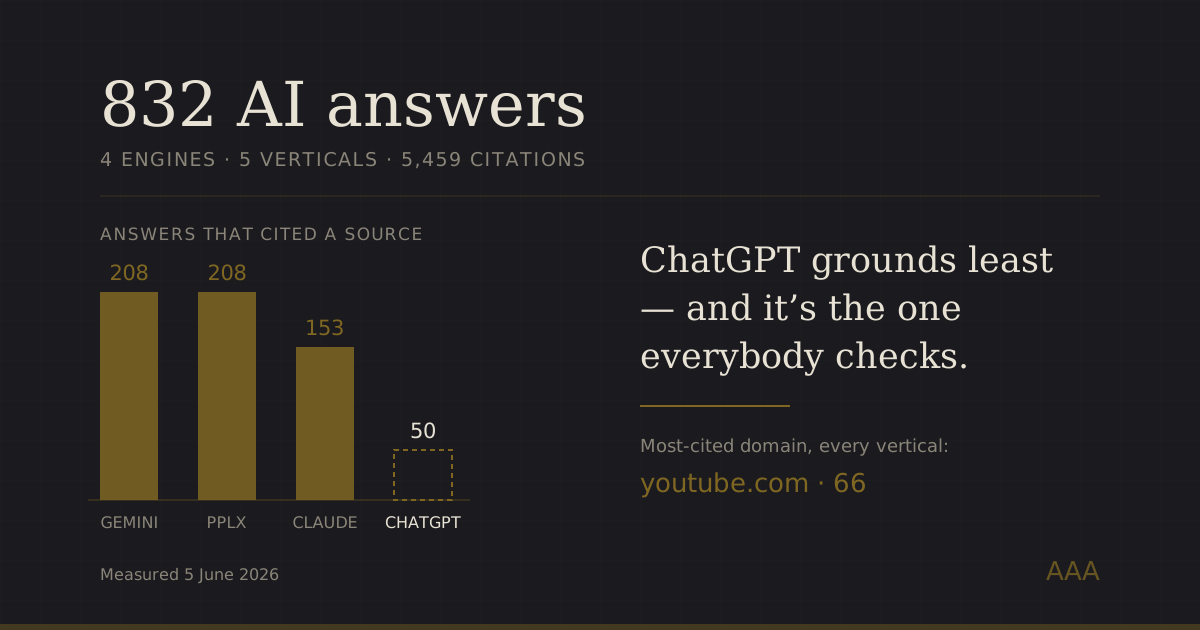
When a buyer asks an AI assistant which company to use, they get a shortlist of three or four names. There is no page two. Either the assistant names you or the buyer never learns you exist. Most businesses have never checked which side of that line they are on, and the ones who do check usually check wrong.
I'm a CA(SA) who builds AI systems and measures AI visibility for a living, so rather than theorise about it I ran the measurement. In June 2026 I put real buyer questions to the four assistants people actually use — ChatGPT, Claude, Perplexity and Gemini — across five South African industries, and read back every source each one cited. Not what the assistants said. What they read to say it.
That produced 832 grounded answers and 5,459 individual citations. Five findings came out of it. Some of them contradict what the market is selling.
What I measured, and what this is not
Five verticals: payments, residential solar, advisory, insurance and online education. Four engines. Prompts written the way buyers actually phrase them, all specifying South Africa or naming SA cities. Data collected 5 June 2026.
Two honest caveats before the findings. First, this is a five-vertical snapshot of 832 answers — the directions are consistent and strong, but the exact percentages will drift, and I re-measure quarterly. Second, this is a different study from the 600-answer analysis of property, banking and crypto I published in June. That one asked which brands get named. This one asks which sources get read. Different samples, different questions, different dates — read them as siblings, not as one number restated.
The underlying idea has an academic foundation. The term GEO comes from a Princeton-led paper presented at KDD 2024, where Pranjal Aggarwal and colleagues showed "that GEO can boost visibility by up to 40% in generative engine responses." What follows is what that looks like in a real market.
Do all AI assistants cite sources equally?
No, and this is the finding that changes how you measure yourself.
| Engine | Answers citing any source | Avg sources per cited answer |
|---|---|---|
| Gemini | 208 | 9.8 |
| Perplexity | 208 | 7.4 |
| Claude | 153 | 10.8 |
| ChatGPT | 50 | 4.9 |
ChatGPT grounded on roughly a quarter as many answers as Gemini or Perplexity, and pulled about half as many sources when it did. I didn't test why: the model was offered search, not forced to use it, and what I measured was OpenAI's API model, not the ChatGPT app you type into.
The practical consequence is uncomfortable: almost everyone checks their AI visibility by typing their brand into ChatGPT. That's one engine, and these four read very different numbers of sources, so one check can't tell you where you stand. Measure all four.
It also means "optimising for AI" isn't one job. The engines that search on nearly every question are won now, by being crawlable and citable today. ChatGPT cited sources on a quarter as many answers here, so being citable reaches it less often, and this study doesn't show what else moves it. Any proposal that doesn't say which engines it's buying you is selling a blur.
Correction, 9 October 2026: an earlier version of this section said ChatGPT relies on its training rather than live retrieval, and that its visibility is won slowly, through the model's memory. The study didn't test why ChatGPT cited fewer sources, and it measured OpenAI's API model, not the ChatGPT app.
Why do South African questions get answered by foreign websites?
Because a third of the sources aren't local. Across all 5,459 citations — on prompts that all named South Africa or an SA city — the split was:
.co.za: 34%.com/.org/.net: 57%- everything else: 9%
US authority sites turned up repeatedly as sources for South African buyer questions. Nerdwallet, Bankrate, the US Chamber of Commerce and several American online-schooling sites all appeared, deciding answers for SA buyers.
Ranking on the local web is necessary and not sufficient. On your own local queries you are competing against international content the engines already trust. The counter is authoritative, genuinely SA-specific content — and because most local competitors haven't built it, the gap is winnable rather than hopeless.
Which single website gets cited most often?
YouTube. Not a competitor, not a directory, not a publication.
youtube.com was cited in 66 answers — more than any brand, aggregator or publication, and it appeared across all five unrelated verticals. Video is the most underweighted surface in AI visibility right now. Almost no audit tooling treats it as a citation channel at all.
For most businesses, a small library of videos that directly answer buyer questions — properly transcribed and indexed — is disproportionately valuable for citation, and almost nobody local is doing it.
Comparison sites decide the shortlist before your brand does
Every vertical had a mediator sitting above the brands in citation volume:
| Vertical | Dominant cited mediator | Brand-side reality |
|---|---|---|
| Insurance | hippo.co.za (41 answers) | brands' own sites cited far less |
| Solar | energybee.co.za, solar.co.za | comparison pages set the shortlist |
| Moving / logistics | wisemove.co.za (29) | — |
| Payments | eezipay.com (27) | international content fills the gap |
| Education | US online-school sites lead | local providers trail |
| Every vertical | youtube.com (66), reddit.com (21) | universal |
This is why the "just build authority" advice underdelivers. The engine often isn't reading brand sites at all for the shortlist question — it's reading the comparison page that ranks the brands. There are two moves: get well represented on the mediators the engines already read, or become one by publishing the comparison content yourself.
What kind of page actually gets cited?
This is the finding I'd act on first, because it's the most specific.
The brands cited most on their own sites also led on share of answers. The leaders in each category had 27–48 citations to their own domain; the two laggards had nine and one. Which way that runs, I didn't test. Being cited may lift share, or a brand that is already strong may simply get cited more.
What stands out is which own pages get cited. Reading the actual cited URLs, the pages cited most are not homepages. They are deep pages that each answer one specific buyer question, in one of two shapes:
- Service pages named for the thing itself. Sable International earns citations on pages like
/south-african-tax/tax-emigration-from-south-africa— the page is named for the question. - Articles shaped exactly like the question. GoSolr earns them on
/enlighten/articles/subscription-vs-ownershipand/solar-system-prices.
Ask an engine about subscription versus ownership solar and it cites the article called subscription-vs-ownership: the page matches the question. That doesn't make question pages what separates leaders from laggards, because one of the trailing brands had a question page cited too. And the sweep recorded only what was cited, so it says nothing about how much a brand publishes, or about news posts.
The best example in the whole dataset: the University of Cape Town's strongest single page is a blog post reviewing twelve leading online high schools, cited eight times. They wrote the category comparison, so the engines cite them as the neutral authority on their own competitive set. That's the "become a mediator" move, caught in the wild.
Correction, 8 October 2026: an earlier version of this section said that question pages are what separate the winners from the losers, that content volume doesn't matter, and that company news posts are almost never cited. The data supports less than that, and the section now says only what it shows.
So is schema markup the answer?
No — and this is where the market's advice and the evidence part company. SE Ranking's study of 129,000 ChatGPT citations found "pages with FAQ schema average 3.6 citations, while those without reach 4.2. This means that schema alone does not significantly increase ChatGPT citation likelihood." My own data agrees: the brand with the most structured data in one vertical sat mid-table.
Schema is hygiene. Do it because it's cheap and correct, not because it's the lever.
What does correlate, in the same study, is freshness — content updated within three months averaged 6 citations against 3.6 for stale pages. And SE Ranking's separate analysis of 100,013 keywords tracks how quickly the AI Overview surface itself keeps shifting.
Why being cited is worth the work
Two independent numbers make the business case.
First, the traffic that used to arrive by clicking is going away. Searches that trigger an AI Overview now show an 83% zero-click rate, against roughly 60% for searches without one.
Second, citation is what recovers some of it. Seer Interactive's April 2026 update, covering 5.47 million queries across 53 brands, found a page cited in an AI Overview gets 120% more organic clicks per impression than one that isn't. Seer is careful about what that proves: "We cannot claim causation. Higher-authority brands are also more likely to be cited." Either way, the correlation is strong enough to act on.
And ranking is not a substitute. Semrush's study of 5,000 queries and over 150,000 citations found only 35% of the URLs cited in Google's AI Mode also appear in Google's own organic top 10 for the same query. You can hold position one and still be absent from the answer above it.
What to do with this
Five findings, five actions, in the order I'd take them:
- Measure all four engines, not ChatGPT. Your ChatGPT result is not your visibility.
- Check you're readable. Google's own documentation is explicit: "To be eligible to be shown as a supporting link in AI Overviews or AI Mode, a page must be indexed and eligible to be shown in Google Search with a snippet, fulfilling the Search technical requirements." If a crawler can't read the page, nothing else on this list matters. What Google says you can ignore about GEO covers what AI crawlers can and can't read.
- Build one question-matched page per real buyer question. Named for the question, answering it in the first sentence. Not a blog.
- Get onto the mediators, or publish the comparison yourself.
- Put your answers on video while the surface is still uncontested.
None of this is exotic. It's the ordinary work of being the most useful, most readable answer to a question your buyer is actually asking — which is roughly what the technical GEO breakdown has been saying, now with the receipts.
If you want to know where your own site sits on the readiness side of this, run my free scan: nine domains, with the weak results shown rather than smoothed. What the engines actually say about you, and who they name instead, is part of The Full Read.
Sources · 7
- GEO: Generative Engine Optimization — Aggarwal et al., KDD 2024
- AI features and your website — Google Search Central
- How Google's AI Mode compares to traditional search — Semrush, 5,000 queries
- AIO Impact on Google CTR: 2026 Update — Seer Interactive, April 2026
- How to optimize for ChatGPT — SE Ranking, 129,000 citations
- Google AI Overviews research — SE Ranking, 100,013 keywords
- What is zero-click search — LLMrefs
Study data collected 5 June 2026 across 832 grounded answers and 5,459 citations in five South African verticals. Figures are reproducible from the run archive; methodology available on request. Percentages will drift — this is re-measured quarterly.