 Auto Alpha Advisory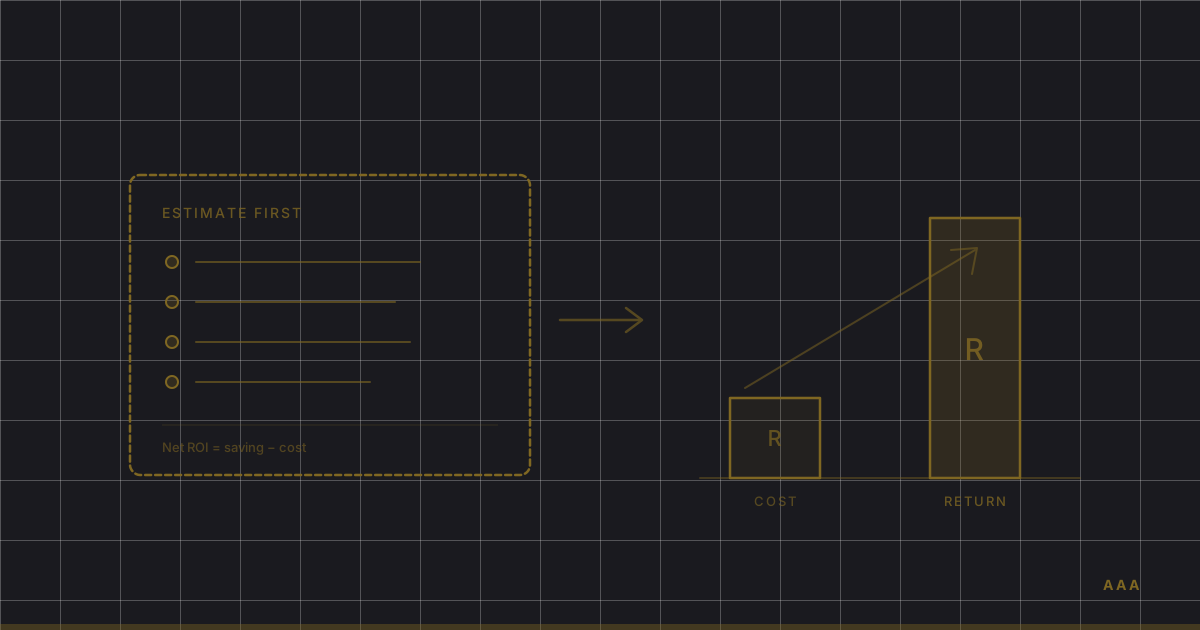
The question I get asked most often isn't "should I use AI?" It's "what is this going to cost me, and how do I know I'll get it back?" That's the right question — and almost nobody selling AI wants to answer the second half of it.
I'm a CA(SA) who builds production AI systems, so I think about this the way a finance director would: not "is the technology impressive" but "what's the rand-in, rand-out, and over what period." This post gives you the real cost ranges for South African businesses in 2026, the simple formula I use to estimate return before committing a cent, and an honest account of where the money disappears.
Start with the uncomfortable backdrop. RAND Corporation studied why AI projects fail and found the failure rate is brutal:
"By some estimates, more than 80 percent of artificial intelligence (AI) projects fail. That is twice the rate of failure for information technology (IT) projects that do not involve AI." — RAND Corporation, The Root Causes of Failure for AI Projects (2024)
MIT's research landed in the same place: an MIT Media Lab study reported in Fortune found that 95% of corporate generative-AI pilots delivered no measurable profit-and-loss impact. And S&P Global Market Intelligence found 42% of companies abandoned most of their AI initiatives in 2025 — up from 17% the year before.
So the cost of AI isn't only the invoice. It's the invoice multiplied by the probability you've spent it on the wrong thing. The way you lower that probability is by estimating the return before you buy. Here's how.
What AI actually costs a business in 2026
There's no single price for "AI" any more than there's a single price for "a vehicle." It depends entirely on what you're buying. Here are the honest ranges I see in the South African market, separated into the two things that actually drive cost: the monthly tool subscription, and the one-off cost of setting it up properly.
Off-the-shelf automations — a meeting-notes summariser, an invoice data extractor, a customer-support triage bot. The tools themselves run R350 to R2,500 per month each. Setup is anywhere from an afternoon (DIY) to R5,000–R30,000 if you want it configured and integrated properly. A stack of ten of these combined still costs under R5,000 per month in subscriptions — the real cost is the configuration, not the running fee.
A mapping session — free. This maps your processes, finds where AI actually fits, and tells you which two or three things to build first. It's the cheapest way to avoid being in the 80%, and it costs nothing but the time. If what you need is narrower — whether your website is legible to AI engines — that's the nine-domain audit at R1,490, one-time.
An implementation sprint — R50,000–R120,000 to take one automation from idea to deployed-in-production over four to eight weeks, integrated with your existing systems.
A custom AI agent — R75,000–R200,000 for a purpose-built function that runs around the clock without you hiring for it. This is the top of the range, and most businesses don't need it yet.
Ongoing advisory or managed automation — a retainer runs R15,000–R40,000 per month; a single managed automation can start from R3,500 per month. Team training, done properly and role-specific rather than a generic "intro to ChatGPT," runs R12,000–R90,000.
Websites are their own category with their own pricing — I've written separately about what a website costs in Cape Town, so I won't repeat it here.
The pattern worth noticing: the monthly tool spend is almost always the small number. The labour to configure, integrate, and maintain is the real cost. Anyone quoting you a price made entirely of software subscriptions is hiding where the work actually is.
The formula I use to estimate ROI before spending a cent
Most AI gets bought on a feeling — a demo looked impressive, a competitor mentioned it, ChatGPT was useful personally. That's how you end up in the 95%. The fix is arithmetic you can do on the back of an envelope before you sign anything. This is the exact model behind the ROI calculator I built for the automations playbook.
For any task you're thinking of automating, you need four numbers:
- How often it happens — times per week.
- How long it takes — minutes per instance, done manually.
- What that time costs — the fully loaded hourly cost of whoever does it.
- What the tool costs — the monthly subscription.
Then:
- Hours saved per week = (frequency × minutes per instance) ÷ 60
- Hours saved per year = that figure × 52
- Annual saving = hours saved per year × hourly cost
- Net annual ROI = annual saving − (monthly tool cost × 12)
That's it. It's deliberately conservative — it only counts labour you stop paying for, not revenue you might gain. A finance director can defend it, which is the point. If the net number isn't comfortably positive on this stripped-down basis, the automation isn't worth doing, regardless of how good the demo was.
What the maths actually looks like
A note on currency: the figures below are in rand, but the formula works in any currency — swap in your own rates. These are illustrative examples, not client results.
A meeting-notes summariser. Say key staff sit in ten meetings a week, each leaving about fifteen minutes of write-up and action-distribution afterwards, and their time costs R350 an hour. That's 2.5 hours saved a week, 130 a year, or R45,500 of recovered time. The tool (Fireflies, Otter, or similar) costs about R500 a month — R6,000 a year. Net annual ROI: roughly R39,500, on a R6,000 spend, with the setup paying for itself inside two months. It's also the easiest thing on this list to switch on — about thirty minutes, no code.
Invoice processing. A firm handling 500 invoices a month, at roughly 2.5 minutes of manual capture each, with admin time costing R300 an hour, is spending about 5.2 hours a week on it. Automate 80% of that and you recover around 216 hours a year — about R64,800. The tool stack to do it runs about R1,000 a month, or R12,000 a year. Net annual ROI: roughly R52,800, with payback under three months. The automations playbook puts the per-invoice cost dropping from about R500 to about R80 once this is running — an 83% reduction.
Neither of these is dramatic. That's the honest part: most real AI ROI is boring and consistent, not spectacular. A well-built customer-support bot handling 60% of routine queries can save far more — into six figures a year for a busy support team — but only if it's configured well enough to actually hit that 60%. A badly built one saves nothing and annoys your customers, which is exactly the kind of project that lands in the failure statistics.
What the formula leaves out — in both directions
The model above is conservative on purpose, so it understates the upside and ignores some real risks. Both matter when you're deciding.
On the upside, it counts none of the following: the revenue you gain when freed-up hours go to billable work instead, the deals you win by responding in minutes instead of days, the errors you stop making, or the simple fact that software works at 2am. Businesses that get AI right report real gains — Salesforce's SMB survey found 91% of small and medium businesses using AI reported measurable revenue increases, though that's self-reported by firms that already chose to adopt, so treat it as the optimistic end. BCG found the leaders pulling away — roughly five times the revenue growth and three times the cost reduction of the laggards.
On the downside, the reason 80% of projects fail rarely has anything to do with the model. It's choosing the wrong process to automate, underestimating the configuration work, skipping change management, or buying a R150,000 custom build when a R500-a-month off-the-shelf tool would have done the job. McKinsey found that only 39% of organisations could link any earnings impact to their AI use at all — most are spending without measuring. The OECD points at a related gap: half of small and medium enterprises say their people lack the skills to use these tools, which is a cost that never shows up in the subscription price.
This is exactly what a readiness audit is for — it's the cheap step that stops you spending the expensive one badly.
How to not be in the 80%
The businesses that get ROI from AI do the same few unglamorous things. They start with one automation, not a platform. They pick it by return-on-effort, not by what's most impressive. They measure the before and after honestly. And they're willing to be told that the right answer is a R500-a-month tool configured properly, not a R100,000 custom build.
BCG's survey of 1,000 executives across 59 countries, Where's the Value in AI?, found the same discipline in the minority who make it pay: they pursue "only about half as many opportunities as their less advanced peers," and scale more than twice as many. Their warning is blunt — as BCG partner Amanda Luther put it: "Three-quarters of companies have yet to unlock value from AI. Without decisive action, they risk falling significantly behind."
The waste is measurable at the other end too. S&P Global Market Intelligence's 2025 survey of 1,006 organisations found "the proportion of companies abandoning most of their AI initiatives before they reach production has risen from 17% to 42%, with the average organization scrapping 46% of their proof-of-concept projects prior to production." Every one of those scrapped proofs-of-concept was budget that a return calculation, done first, would have redirected.
A business with fourteen manual processes usually only needs to automate three of them. Finding which three — and pricing the return before you commit — is most of the value. The global money is pouring in regardless: Stanford's AI Index put 2025 corporate AI investment at $581.7 billion, and Gartner forecasts worldwide AI spending to grow 47% in 2026. The question isn't whether to spend. It's whether you can show the return before you do.
Frequently Asked Questions
How much does it cost to implement AI in a small business in South Africa?
It ranges from a few hundred rand a month for an off-the-shelf tool to R75,000–R200,000 for a custom-built AI agent. Most South African small businesses start far cheaper than they expect: a stack of useful automations runs under R5,000 a month in subscriptions, and the larger cost is the one-off work to set it up properly.
What's the ROI of AI for a small business?
It depends entirely on what you automate, but the realistic shape is recovering staff hours on repetitive work. A single well-chosen automation often returns R40,000–R60,000 a year against a R6,000–R12,000 annual cost, paying for itself within three months. The dramatic returns exist but are rarer and riskier; the dependable ones are modest and add up.
How long until AI pays for itself?
For a well-chosen first automation, usually one to three months. If a proposed project can't show payback inside a year on a conservative, labour-savings-only basis, that's a strong signal to either rescope it or not do it.
Is a custom AI agent worth the cost?
Sometimes, but most businesses reach for one too early. At R75,000–R200,000, a custom agent only makes sense once you've proven the value with cheaper off-the-shelf tools and have a function that genuinely needs to run 24/7. If you haven't done the arithmetic above, you're not ready to spend at that level.
How do I estimate AI ROI before I spend anything?
Take the task you want to automate and write down four numbers: how often it happens, how long it takes manually, what that hour costs, and the monthly tool fee. Hours saved per week times 52 times the hourly cost, minus the annual tool cost, is your net return. Do it before you talk to any vendor.
The short version: AI is worth it when you can show the return before you spend, and a waste when you can't. If you want help running that arithmetic on your own processes, the free automations playbook has the tools and ZAR costs laid out, and a readiness audit does it properly for your specific business. Or book a discovery call — 30 minutes, no pitch, just an honest read on whether the numbers work. It's the other side of the coin to the real cost of ignoring AI — both come down to doing the maths first.
Sources · 9
- RAND Corporation — The Root Causes of Failure for AI Projects (>80% of AI projects fail, 2× the non-AI IT rate)
- MIT Media Lab research, reported in Fortune (2025) (95% of GenAI pilots show no P&L impact)
- S&P Global Market Intelligence (2025) (42% abandoned most AI initiatives in 2025)
- McKinsey — The State of AI (2025) (only 39% can link any EBIT impact to AI)
- Salesforce — SMB Trends Report (2024) (91% of AI-using SMBs report revenue increases — self-reported)
- BCG — Are You Generating Value from AI? (2025) (leaders see ~5× revenue and ~3× cost gains over laggards)
- OECD — AI Adoption by SMEs (2025) (half of SMEs report a GenAI skills gap)
- Stanford HAI — AI Index Report 2026 ($581.7bn global corporate AI investment in 2025)
- Gartner — Worldwide AI Spending Forecast (2026) (AI spending forecast to grow 47% in 2026)